

Can I Use the Maps Attached to My Deeds for First Property Registration?


One of the most common questions we receive from both property owners and solicitors is: Can I use the maps attached to my deeds for first property registration -"The deeds already contain maps. Can we simply use those for first registration?"
Unfortunately, the answer is no.
While the maps attached to deeds, transfers, conveyances and leases are often useful reference documents, they were generally prepared for a different purpose and do not meet the current mapping requirements of the Property Registration Authority (PRAI) and Tailte Éireann.
Many people assume that because a map appears on their deeds, it will automatically be accepted for registration. In reality, this is one of the most common causes of delays and mapping queries during the first registration process.
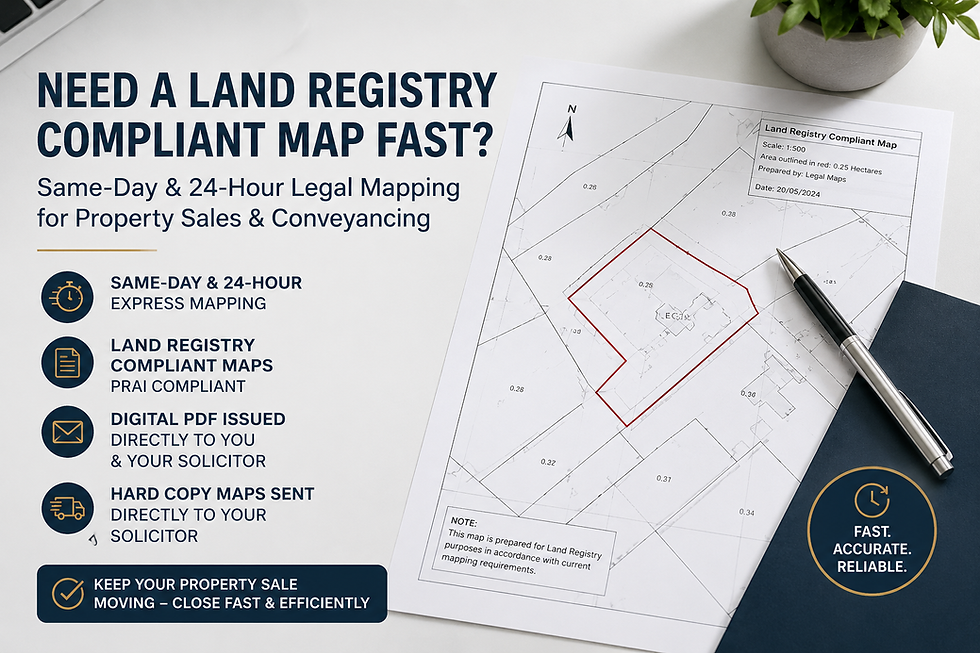
If you're unfamiliar with the current requirements, check out our guide to What is a Land Registry Compliant Map?
Can I use the maps attached to my deeds for first property registration? and Why Existing Deed Maps Are Often Not Accepted
Historically, deed maps were prepared simply to identify the property being transferred between parties. Their purpose was to show ownership rather than satisfy the technical requirements of a modern registration application.
Many deed maps were prepared years or even decades ago. Some were hand-marked, based on historic mapping, or produced before current digital mapping standards existed.
As a result, they often lack information now required for a first registration application.
This does not mean there is anything wrong with the title deeds themselves. It simply means that the maps attached to them do not meet the standards required by the PRAI.
What Changed in 2022?
A significant source of confusion today relates to the mapping changes introduced by Tailte Éireann in December 2022.
Prior to these changes, some maps were considered compliant and were sometimes accepted by the Land Registry. However, updated mapping requirements introduced new standards relating to presentation, layout, mapping references and supporting information.
We regularly encounter situations where:
Maps were prepared correctly several years ago
The property transaction did not proceed immediately
The application was only lodged recently
The mapping was subsequently queried or rejected under the updated requirements
This issue is particularly common in apartment, duplex and older first registration applications.
A map that was perfectly acceptable when prepared in 2019 or 2020 will not satisfy the requirements applied to an application lodged today.
If your PRAI maps were prepared before December 2022, it is worth having them reviewed before submission, as they might not be up to standard. See why some apartment registration maps are currently being rejected today.
You may also find our First Property Registration: A Step-by-Step Guide useful.
What Information May Be Missing from my exisitng deed maps and floor plans?
Depending on the property type, current PRAI-compliant mapping require:
Tailte Éireann compliant base mapping
ITM (Irish Transverse Mercator) coordinates
Appropriate map scales
Updated layout and presentation standards
Floor plans drawn to recognised scales
Building level identification
Height information for apartments and duplexes
Cross-referencing between site maps and floor plans
The exact requirements vary depending on the property and the type of application being made.
This is why a map that appears perfectly clear to a property owner may still be considered non-compliant from a registration perspective.
Apartments and Duplexes Require Particular Care
Apartment and duplex registrations are considerably more complex than standard residential properties. Am aparemnt/duplex/multi floor compliant application will require:
A site location map
One or more floor plans
Parking space mapping
Storage unit mapping
Identification of rights of way
Identification of rights of use
Many apartment owners assume that because their lease contains a floor plan, no further mapping work is required.
In reality, the lease plan is only the starting point.
The existing plans help identify the property, but new compliant mapping will still be required to satisfy current PRAI requirements.
This is one of the reasons apartment registrations frequently attract mapping queries when compared with standard house registrations.
What About Parking Spaces and Storage Areas?
Parking spaces are one of the most common areas where difficulties arise.
In some developments, the parking space forms part of the property being registered. In others, the owner simply enjoys a right to use a particular space under the terms of a lease.
The distinction can be important and should be carefully reviewed before maps are finalised.
The same principle applies to storage units, bicycle stores and other ancillary areas.
This is one reason why solicitors will often review maps carefully before they are lodged.
If New Maps Are Needed, Does a Site Survey Have to Be Carried Out?
In some cases, existing deed maps, lease plans, architectural drawings and supporting documentation provide enough information for compliant maps to be prepared.
Where additional information is required, a site visit or measured survey may be necessary, but this is assessed on a case-by-case basis.
A review of the existing documentation will usually identify the most efficient and cost-effective approach.
Why Solicitors Still Review Mapping
Even when mapping is technically compliant, solicitors will often review it before submission.
This is entirely normal and forms an important part of the registration process.
The review helps ensure that the maps accurately reflect the legal documentation and correctly identify:
Rights of use
Rights of way
Parking entitlements
Storage areas
Common areas
Property boundaries
Mapping and legal title must work together for a successful application.
Can Existing Floor Plan Maps Ever Be Reused?
Almost certainly no, BUT... occasionally, yes:
This is only where compliant PRAI mapping has been prepared relatively recently (after December 2022) and remains consistent with current requirements, it may still be suitable for use. Or if your architect has overseen the design and build of your property, and holds the origonal CAD files, that they can then overlay the additional mapping info without having to draw floor plans from scratch - which can save you money on the mapping fees.
However, this is the exception rather than the rule.
Every property should be assessed individually before assuming that existing deed maps will be accepted, as from our experience, deed maps are not accepable and will be refused.
The Cost of Getting It Wrong
Submitting unsuitable maps can result in:
PRAI mapping queries
Rejection notices
Delays in registration
Additional professional fees
Further correspondence between solicitors and mapping consultants
In many cases, having the maps reviewed at the outset can save both time and money.
You can view our current Land Registry compliant mapping fees and apartment mapping costs
Real-World Example
A situation we encounter regularly involves a property owner or solicitor presenting maps that were originally prepared for an earlier transaction, sometimes several years prior.
At the time those maps were produced, they may have been entirely compliant and would have been accepted without issue. However, because the registration application is only being lodged now, the mapping is assessed against the standards that apply today and not those that applied when the maps were first drawn.
In one typical scenario, an apartment owner had a floor plan prepared in 2020 as part of a planned sale that didn't go ahead. When the property eventually sold and the first registration application was lodged in 2024, the existing floor plan lacked ITM coordinates, correct scale notation, and building level identification - all requirements introduced or tightened under the 2022 changes.
The result was a mapping query from the PRAI, additional professional fees, and a delay of several weeks/months to their registration.
Having the maps reviewed before submission would have identified the issue at the outset and avoided the delay entirely.
The Bottom Line
The maps attached to your deeds are often an excellent starting point, but they are not the final product required for first registration.
A map that accurately identifies a property for conveyancing purposes does not automatically satisfy current PRAI and Tailte Éireann mapping requirements.
If you are unsure whether your existing maps are suitable, it is worth obtaining a professional review before submitting your application.
At Legal Maps, we review deed maps, lease plans and first registration documentation every day. In the vast majority of cases, existing deed maps will not meet the current Tailte Éireann mapping requirements introduced in December 2022, and new compliant maps will need to be prepared. We will assess your existing documentation, identify exactly what is required, and provide you with a clear price for producing a fully compliant map set in line with the current standards.
A short review now can help avoid delays, queries and unexpected costs later in the registration process.
Not sure if your maps are compliant?
We'll assess your existing documentation and let you know exactly what's needed, usually within one working day.


Comments